Review and Preview 421 Core Connections Geometry Answers
Core Connections Geometry
Core Connections Geometry is the 2d course in a 5-twelvemonth sequence of college preparatory mathematics courses that starts with Algebra I and continues through Calculus. Information technology aims to formalize and extend the geometry that students have learned in previous courses. Information technology does this by focusing on establishing triangle congruence criteria using rigid motions and formal constructions and edifice a formal understanding of similarity based on dilations and proportional reasoning. It also helps students develop the concepts of formal proof, explore the properties of ii- and three-dimensional objects, work within the rectangular coordinate organisation to verify geometric relationships and prove basic theorems about circles. Students as well utilize the linguistic communication of fix theory to compute and interpret probabilities for chemical compound events. Read more most Core Connections Geometry.
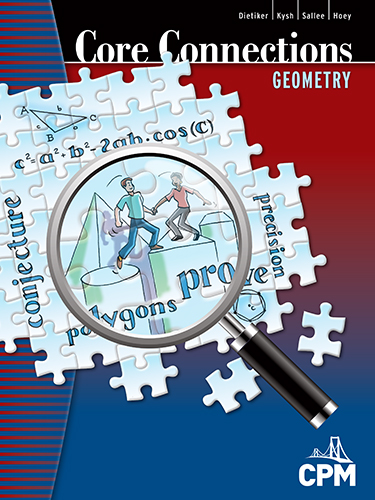
Cadre Connections Geometry Book Cover
LESSON Construction
The Core Connections courses are congenital on rich, meaningful problems and investigations that develop conceptual understanding of the mathematics and institute connections among dissimilar concepts. The lesson problems are not-routine and team-worthy, requiring strategic problem solving and collaboration. Throughout the course, students are encouraged to justify their reasoning, communicate their thinking, and generalize patterns. Read more almost the lesson structure.
Course Structure
Chapters are divided into sections that are organized around core topics. Within each department, lessons include activities, challenging problems, investigations and exercise problems. Teacher notes for each lesson include a "suggested lesson activity" section with ideas for lesson introduction, specific tips and strategies for lesson implementation to clearly convey cadre ideas, and a means for bringing the lesson to closure. Read more virtually the grade structure.
ADDITIONAL TEXTBOOK RESOURCES
Correlations
Table of Contents
| Opening | ane.OP | Affiliate Opening |
|---|---|---|
| Department 1.ane | ane.1.i | Creating Quilt Using Symmetry |
| 1.i.2 | Making Predictions and Investigating Results | |
| ane.ane.three | Perimeter and Areas of Enlarging Tile Patterns | |
| i.1.4 | Logical Arguments | |
| 1.one.5 | Building a Kaleidoscope | |
| Section 1.two | 1.2.i | Spatial Visualization and Reflectionn |
| one.ii.ii | Rigid Transformations: Rotations and Translations | |
| 1.2.3 | Slope of Parallel and Perpendicular Lines | |
| i.ii.4 | Using Transformations | |
| ane.2.v | Using Transformations to Create Shapes | |
| 1.2.6 | Symmetry | |
| Section 1.3 | 1.3.1 | Attributes and Characteristics of Shapes |
| 1.three.2 | More than Characteristics of Shapes | |
| Closure | 1.CL | Chapter Closure |
| Opening | 2.OP | Chapter Opening |
|---|---|---|
| Section ii.1 | 2.1.1 | Complementary, Supplementary, and Vertical Angles |
| 2.i.ii | Angles Formed by Transversals | |
| two.ane.iii | More Angles Formed by Transversals | |
| two.1.iv | Angles in a Triangles | |
| two.one.5 | Applying Bending Relationships | |
| Section two.2 | 2.2.1 | Units of Measure |
| ii.2.ii | Areas of Triangles and Composite Shapes | |
| 2.ii.3 | Areas of Parallelograms and Trapezoids | |
| ii.two.4 | Heights and Areas | |
| Department 2.3 | two.iii.ane | Triangle Inequality |
| 2.3.ii | The Pythagorean Theorem | |
| Closure | ii.CL | Chapter Closure |
| Opening | 3.OP | Chapter Opening |
|---|---|---|
| Section 3.1 | 3.1.1 | Dilations |
| three.one.2 | Similarity | |
| three.i.three | Using Ratios of Similarity | |
| 3.1.four | Applications and Notation | |
| Section 3.ii | iii.ii.1 | Atmospheric condition for Triangle Similarity |
| 3.2.two | Creating a Flowchart | |
| three.2.3 | Triangle Similarity and Congruence | |
| 3.2.four | More Conditions for Triangle Similarity | |
| 3.2.5 | Determining Similarity | |
| 3.2.half dozen | Applying Similarity | |
| Closure | 3.CL | Chapter Closure |
| Opening | 4.OP | Chapter Opening |
|---|---|---|
| Section 4.1 | 4.i.1 | Constant Ratios in Right Triangles |
| 4.1.2 | Connecting Slope Ratios to Specific Angles | |
| four.i.3 | Expanding the Trig Table | |
| iv.ane.iv | The Tangent Ratio | |
| 4.i.5 | Applying the Tangent Ratio | |
| Section 4.2 | iv.2.ane | Using an Area Model |
| iv.2.ii | Using a Tree Diagram | |
| 4.ii.3 | Probability Models | |
| four.two.iv | Unions, Intersections, and Complements | |
| iv.2.5 | Expected Value | |
| Closure | 4.CL | Affiliate Closure |
| Opening | v.OP | Chapter Opening |
|---|---|---|
| Section five.1 | 5.ane.1 | Sine and Cosine Ratios |
| v.1.2 | Selecting a Trig Tool | |
| 5.1.3 | Changed Trigonometry | |
| 5.1.iv | Applications | |
| Section 5.2 | 5.ii.1 | Special Right Triangles |
| 5.ii.2 | Pythagorean Triples | |
| Section v.3 | v.3.1 | Finding Missing Parts of Triangles |
| five.3.ii | Law of Sines | |
| five.3.3 | Police of Cosines | |
| five.three.4 | Ambiguous Triangles (Optional) | |
| 5.3.v | Choosing a Tool | |
| Closure | 5.CL | Chapter Closure |
| Opening | 6.OP | Chapter Opening |
|---|---|---|
| Department 6.one | 6.i.1 | Congruent Triangles |
| 6.1.2 | Atmospheric condition for Triangle Congruence | |
| 6.1.3 | Congruence of Triangles Through Rigid Transformations | |
| 6.i.4 | Flowcharts for Congruence | |
| half dozen.i.5 | Converses | |
| Section 6.2 | 6.2.1 | Angles on a Pool Tabular array |
| 6.2.2 | Investigating a Triangle | |
| 6.2.three | Creating a Mathematical Model | |
| half-dozen.2.4 | Analyzing a Game | |
| 6.2.5 | Using Transformations and Symmetry to Design Snowflakes | |
| Closure | 6.CL | Chapter Closure |
| Opening | 7.OP | Chapter Opening |
|---|---|---|
| Section vii.ane | 7.one.1 | Properties of a Circumvolve |
| 7.1.2 | Building a Tetrahedron | |
| 7.1.3 | Shortest Distance Problems | |
| 7.one.4 | Using Symmetry to Study Polygons | |
| Department 7.two | 7.2.1 | Special Quadrilaterals and Proof |
| 7.2.2 | Properties of Rhombi | |
| 7.2.three | More Proof with Coinciding Triangles | |
| 7.ii.4 | More Properties of Quadrilaterals | |
| 7.ii.five | 2-Cavalcade Proofs | |
| 7.2.6 | Explore-Conjecture-Prove | |
| Section vii.3 | 7.iii.i | Studying Quadrilaterals on a Coordinate Grid |
| 7.three.two | Coordinate Geometry and Midpoints | |
| 7.3.3 | Identifying Quadrilaterals on a Coordinate Grid | |
| Closure | 7.CL | Chapter Closure |
| Opening | 8.OP | Affiliate Opening |
|---|---|---|
| Section viii.1 | eight.1.1 | Pinwheels and Polygons |
| viii.ane.2 | Interior Angles of a Polygon | |
| 8.i.3 | Angles of Regular Polygons | |
| 8.1.four | Regular Polygon Bending Connections | |
| 8.1.five | Finding Areas of Regular Polygons | |
| Section 8.ii | viii.ii.i | Area Ratios of Similar Figures |
| 8.2.2 | Ratios of Similarity | |
| Department 8.3 | viii.iii.1 | A Special Ratio |
| 8.3.2 | Area and Circumference of a Circle | |
| 8.iii.iii | Circles in Context | |
| Closure | 8.CL | Affiliate Closure |
| Opening | 9.OP | Affiliate Opening |
|---|---|---|
| Section 9.1 | 9.1.1 | 3-Dimensional Solids |
| 9.1.two | Volume and Surface Expanse of Prisms | |
| 9.1.iii | Prisms and Cylinders | |
| ix.1.four | Volumes of Similar Solids | |
| nine.i.five | Ratios of Similarity | |
| Section 9.two | 9.2.1 | Introduction to Constructions |
| 9.ii.2 | Amalgam Bisectors | |
| nine.2.3 | More Explorations with Constructions | |
| nine.2.4 | Other Constructions | |
| Closure | 9.CL | Chapter Closure |
| Opening | 10.OP | Chapter Opening |
|---|---|---|
| Section 10.ane | 10.1.1 | Introduction to Chords |
| 10.1.ii | Angles and Arcs | |
| 10.1.3 | Chords and Angles | |
| 10.1.iv | Tangents and Secants | |
| 10.i.5 | Problem Solving with Circles | |
| Section 10.2 | x.2.1 | Conditional Probability and Independence |
| 10.2.2 | Two-Way Tables | |
| 10.2.3 | Applications of Probability | |
| Section 10.3 | 10.3.one | The Fundamental Principle of Counting |
| 10.3.ii | Permutations | |
| x.iii.3 | Combinations | |
| 10.three.4 | Categorizing Counting Bug | |
| x.3.v | Some Challenging Probability Issues | |
| Closure | 10.CL | Affiliate Closure |
| Opening | 11.OP | Chapter Opening |
|---|---|---|
| Section xi.1 | eleven.1.one | Platonic Solids |
| 11.1.ii | Pyramids | |
| 11.1.3 | Volume of a Pyramid | |
| xi.1.4 | Surface Expanse and Book of a Cone | |
| 11.i.5 | Surface Area and Book of a Sphere | |
| Section eleven.2 | eleven.2.1 | Coordinates on a Sphere |
| 11.2.ii | Tangents and Arcs | |
| 11.ii.three | Secant and Tangent Relationships | |
| Closure | 11.CL | Affiliate Closure |
| Opening | 12.OP | Affiliate Opening |
|---|---|---|
| Section 12.1 | 12.one.1 | The Equation of a Circumvolve |
| 12.1.2 | Completing the Square for Equations of Circles | |
| 12.one.3 | Introduction to Conic Sections | |
| 12.1.iv | Graphing a Parabola Using the Focus and Directrix | |
| Department 12.2 | 12.ii.1 | Using Coordinate Geometry and Construction to Explore Shapes |
| 12.2.two | Euler'south Formula for Polyhedra | |
| 12.2.3 | The Golden Ratio | |
| 12.ii.four | Using Geometry to Observe Probability | |
| Closure | 12.CL | Chapter Closure |
| CP i: | Solving Linear Equations | |
|---|---|---|
| CP 2: | Solving Linear Systems of Equations | |
| CP 3: | Linear Equations from Multiple Representations | |
| CP 4: | Finding the Areas and Perimeters of Complex Shapes | |
| CP 5A: | Multiplying Polynomials and Solving Quadratics | |
| CP 5B: | Writing Equations for Arithmetics and Geometric Sequences | |
| CP vi: | Solving Proportional Equations and Similar Figures | |
| CP 7: | Solving with Trigonometric Ratios and the Pythagorean Theorem | |
| CP 8: | Angle Relationships in Triangles and Lines | |
| CP 9A: | Probabilities with Unions, Intersections, and Complements | |
| CP 9B: | Exponential Functions | |
| CP x: | Finding Angles in and Areas of Regular Polygons | |
| CP xi: | Volumes and Surface Areas of Prisms and Cylinders |
smithmorguitainne95.blogspot.com
Source: https://cpm.org/ccg
0 Response to "Review and Preview 421 Core Connections Geometry Answers"
Post a Comment