What Was Happening to Native American and Hispanic Art During This Period
Much can be learnt well-nigh the Native American fashion of life by studying their artistic talents. Interestingly, back before the first century, fifty-fifty the term 'fine art' was a foreign notion, saved for the Europeans rather than the Americans, who did not view the creative concept as a meaning part of their society. These days, even so, the demand for Native American pieces is increasing, as we brainstorm to appreciate the true beauty of the art they were so dismissive of.
Back to the Beginning
That is not to say that the aboriginal Native Americans did non admire beautiful things, they just appreciated it in terms of quality rather than aesthetics – a well-crafted basket, for example, would always exist preferable to ane that had been clumsily put together. It is just that art was never considered to be a vocation on its own.
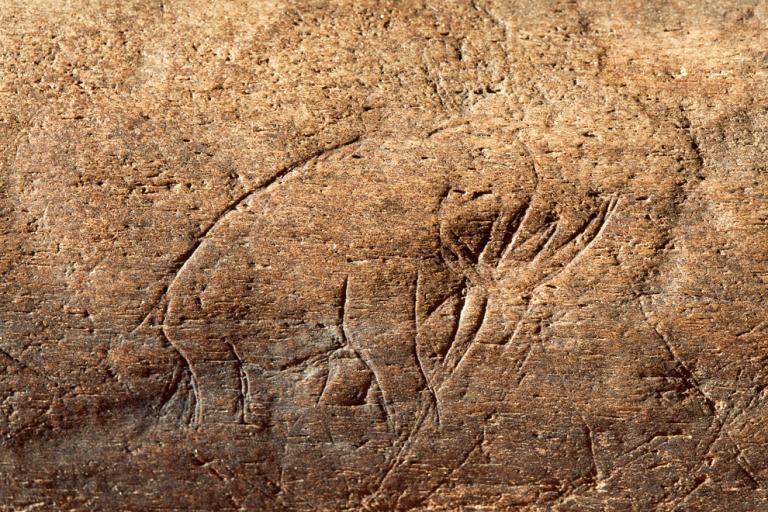
The history of Native American art can be traced back well before the first century, with the showtime recorded piece created over thirteen-thousand years ago. Discovered nearly Vero Beach, Florida, the image of a mammoth surrounded past cross-hatched designs had been carved into a megafauna os.
The Native Americans were not afraid to experiment with unlike kinds of art, including sand and oil paintings, basket weaving, crafts, ceramics and wood carvings. It was mostly the women who would enjoy spending hours weaving the baskets or blankets to create bright and intricate patterns, with the Navajo tribe being particularly celebrated for their rainbow blankets.
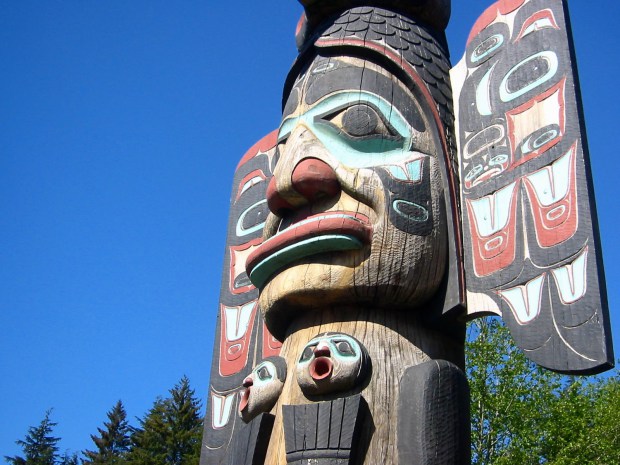
The men tended to prefer to carve their designs and in colder areas they would use objects such as whales' teeth and rocks every bit a canvas for the depictions of the animals they relied on. They would frequently create pendants and statues, including the notorious totem pole, a famous example of Native American art that is an extremely important part of their heritage. The totem pole is made up of iii or more animate being effigies, the spirit of which is thought to be with you lot for life. Each fellow member of a tribe is allocated upwardly to ix spirit animals, depending on the grapheme qualities they share and the creatures they have a natural affinity with, and these are depicted in the totem pole. Of course, the totem animals were restricted to creatures that the indigenous population were familiar with, but they could too exist represented in emblems, crests, figurines and individual stone carvings.
Time Matters
The next recorded item wasn't made until years later, merely it seems that there was no stopping the Native Americans one time they got started. One of the most notable pieces includes a 12-foot monolithic calendar stone believed to have been created in 1479, which now sits in the National Anthropology Museum in United mexican states. It did hang on the exterior wall of the United mexican states City Cathedral for some time later on it was rediscovered there in 1790 when repairs were beingness undertaken. It was moved in 1885.
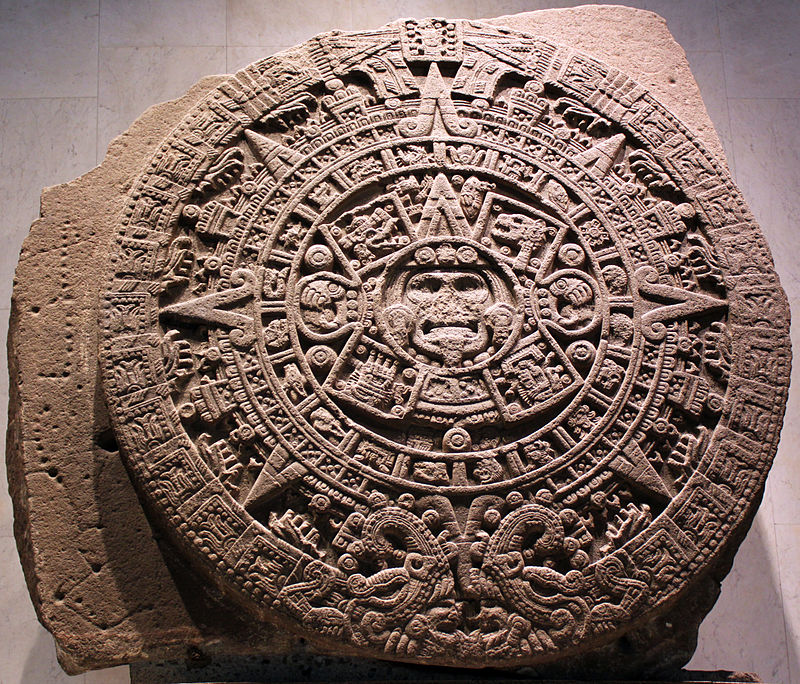
The circular stone has been carved with markings based on the ancient Mexican cosmogony, with the god of the lord's day in the centre, holding a human center in each of his hands. The deity'due south natural language is represented as a knife to stand for a human being sacrifice. This image is cushioned with four squares, intended to represent the past, or the iv previous suns. The Aztecs believed that there had been four eras prior to theirs, all of which had concluded in chaos. The commencement square was intended to show the final day of the Jaguar era, when monsters arrived on globe and consumed humanity. The 2nd foursquare shows the air current era, which concluded in hurricanes and all people were turned into monkeys. The third square or era is for the rains of fire which turned flesh into turkeys and the fourth era is for the waters that flooded the world and turned anybody into fish.
This sun rock image has become and so popular in modern culture that it tin now exist institute on the Mexican 20 Peso gold coins.
Ledger Fine art
In the 1860's, the Native Americans gave nascence to ledger art, which referred to whatever epitome drawn or painted on paper or fabric. It is believed that accounting ledger books were oft the fabric choice, which was the reason for the name. This style of art became popular afterward years of decorating buffalo hides – equally the buffalo numbers dwindled thanks to United states of america government eradication programmes, the indigenous population had to notice other ways to express their inventiveness.
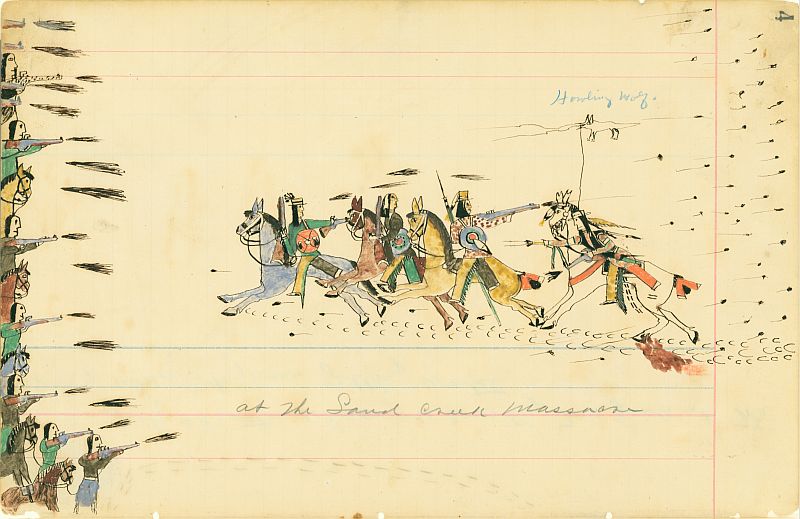
Traditionally, art made by men and women was very different. Men preferred to draw images of battle, boasting their ain conquests through their designs equally a way to gain respect throughout their tribe. Female person art was more abstract, with geometrical shapes, but both sexes would use a thick outline filled with solid blocks of colour – detail was unimportant at the fourth dimension.
Ledger art represented a time of change in the Native American's lifestyles. As paper and other drawing materials became available, there was no need to use their previous tools of choice, which included os or wood saturated in mineral pigments. They were able to maintain a nomadic lifestyle with the implements given to them by traders and government workers, but the artistic traditions were given a modern overhaul.
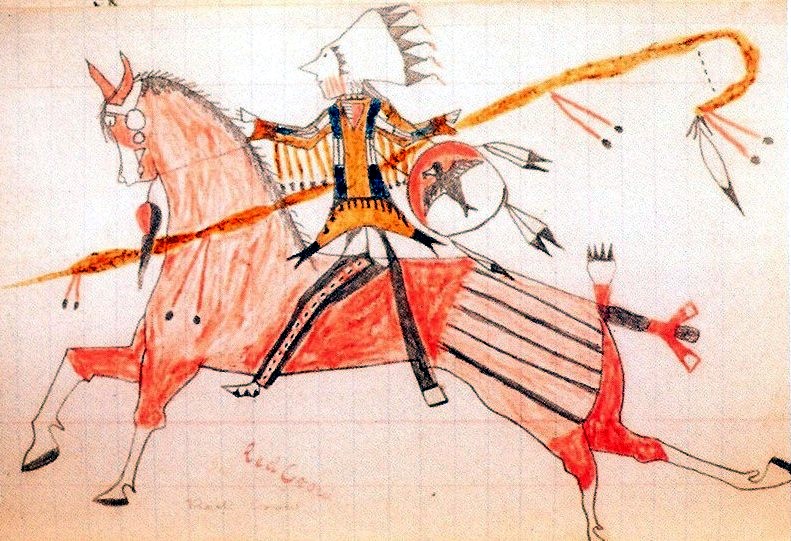
Some of the most celebrated pieces of ledger art were actually produced by prisoners of state of war at Fort Marion in Florida. It was known equally the Red River War and was between Native American tribes and the U.s.a. regime during the afore mentioned eradication programme. The government believed that the Native Americans would take to adjust to domesticated life if they did non have the buffalo to rely on, then they intended to slaughter every single wild buffalo in the land. Various tribes banded together to protect the last complimentary herd of buffalo, with many of the leaders captured and held prisoner. The regime used this as an opportunity to endeavour and 'westernise' the tribes, giving them basic art supplies to utilize while held captive. As you lot might wait, the chief theme was boxing, since this was a field of study and so close to their minds, but they also drew animals, romantic scenes and political images portraying their emotions regarding the civilised societies encroaching on their territory. Many of the prisoners continued to describe afterwards their release.
Mod-Day Native American Fine art
These days, you don't have to become an archeologist to bask Native American art. The motility is nevertheless thriving, with many fine art galleries around the US portraying mod solar day pieces and festivals celebrating their work such every bit the Biennial of Indigenous Art and Culture in Santiago. If information technology is older items you wish to meet, at that place are too museums including the National Museum of the American Indian in Washington DC which opened in 2004. Native Americans are as well making their mark on more formal art events such equally the Venice Biennale.
One of the biggest breakthroughs for Native American art came from Jereldine Redcorn (Caddo), who has a piece of pottery displayed in the Oval Function in the White House. She has been credited with single-handedly bringing back one of the ancient traditions of ceramic art. Having visited the Museum of the Cherry-red River in Oklahoma, she become obsessed with learning the techniques of her ancestors, shunning mod-day implements in favour of bone and metallic tools and coiling the dirt and hand-firing information technology for an authentic finish.
Sources:
- https://www.britannica.com/art/Native-American-art
- https://www.revolvy.com/topic/Aztec%20calendar%20stone&item_type=topic
- https://en.wikipedia.org/wiki/Ledger_art
- http://indians.org/manufactures/native-american-art.html
- https://en.wikipedia.org/wiki/Timeline_of_Native_American_art_history
- https://www.legendsofamerica.com/na-totems/
- https://news.nationalgeographic.com/news/2011/06/110622-mammoth-os-oldest-art-americas-science/#/36837.jpg
- https://en.wikipedia.org/wiki/Aztec_calendar_stone
smithmorguitainne95.blogspot.com
Source: https://www.artsupplies.co.uk/blog/the-history-of-native-american-art/
0 Response to "What Was Happening to Native American and Hispanic Art During This Period"
Post a Comment